
Goal Setting and Rewards
Setting goals can be a useful tool when making lifestyle changes as a family. They can help us to:
- Eat a variety of healthy and nutritious foods
- Be more physically active
- Spend less time being inactive
Agreeing non-food-based rewards can give us incentive to achieve our goals.
We will explore goal setting and rewards in more detail in this section of Thrive Highland.
Benefits of Goal Setting
- Allow small, progressive changes towards a bigger outcome
- Help to focus conversations around lifestyle changes
- Allow children to be involved and take a gentle form of responsibility
- Ability to set our own, individualised goals
- Help families to develop self-management and problem solving skills
Goals should be S.M.A.R.T.
Specific, measurable, achievable, realistic and timely. For example:
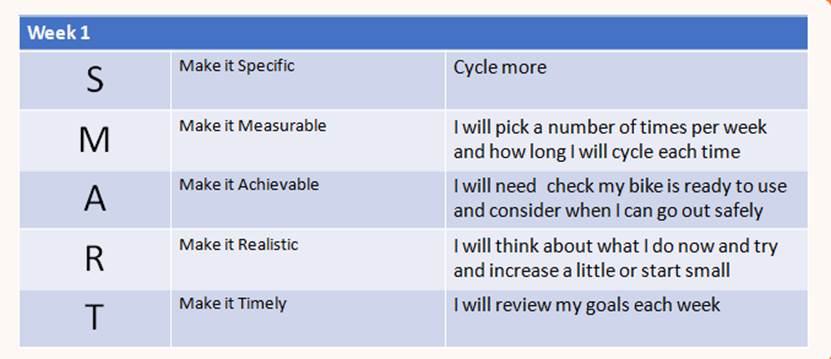
We recommend setting no more than three SMART goals per week. For example:
1-2 goals focusing on being more active, or less inactive
1-2 food-based goals
Rewards
Rewards are an important part of the process of goal setting. Praise and rewards reinforce desired behaviour and motivate your child to continue.
Praise should be given throughout the week when your child demonstrates behaviour related to the agreed goals, but rewards only given on successful completion of the agreed goals at the end of each week. Once a reward has been agreed or given to a child, it must not be taken away.
It is best for rewards to be given as close as possible to the time that the child achieves their goals. It is also important not to issue the reward if the goals are not achieved.
Rewards should be non-food based, of interest to your child and acceptable/ achievable for parents.
Agree a list of suitable rewards with your child, some examples are:
- Staying up later on a Friday or Saturday night
- Having friends over
- Playing with friends after school
- Going to shopping centre with friends
- Playing their favourite game as a family
- A comic/magazine or book
- Family day out
- A new colouring book, art or craft supply
- A new toy, jigsaw or puzzle
What if I don’t achieve my goal?
Lapses (or a one-off slip from our healthy lifestyle goals) are a very normal part of making changes and happen to everyone. Lapses are not a sign of failure and do not undo any hard work we have done in making changes so far.
We can’t avoid all tricky situations, but we can plan ahead (or learn from past tricky situations) to help us cope and achieve our goals.
Top tips for managing lapses
- Plan ahead and list possible challenges which may get in the way of us achieving our goals. Make a second list of possible solutions to these challenges.
- If we do have a lapse, pause and don’t panic! Remember lapses are a normal part of change and do not mean failure.
- We can get back on track anytime. Start by setting a small and achievable goal relating to our current situation and build on that.
- List all of the positive changes we have made to date and progress so far. Try to get back on track with these previous changes as soon as possible.
- Use lapses as a learning opportunity. What might have triggered the situation? What might help us to manage this situation in the future if it happens again? Be kind to yourself! Was the lapse completely out with our control?
Planning for tricky situations, example:
Plan: Go for a bike ride with my family
Tricky situation: Rain
Possible solutions: Wear waterproof clothing. Change activity to an indoor one such as swimming or an at home activity video
